No products in the cart.
Manufacturers need clear, permanent markings to identify products, display serial numbers and maintain traceability. Fiber laser marking machines offer a precise, non-contact way to mark metal components and several other compatible materials. A Fiber Laser Marker can create text, logos, barcodes, QR codes and identification details without using ink, labels or physical engraving tools. However, choosing the right machine requires more than comparing its power rating. Understanding its working principle, laser source, marking capabilities and material compatibility helps businesses make a practical investment.
What Are Fiber Laser Marking Machines?
The basic concept behind the fiber laser marking machine is the formation of permanent markings by laser beams through an optical fibre on the surface of the materials. The lasers are used with a wavelength of approximately 1,064 nm in the infrared region, thus making them appropriate for marking metals.
Unlike conventional printing techniques, there is no use of ink in the process and there is no physical contact between the product and the printer during the whole process.
The companies use this technology to mark the names of their products, codes, serial numbers, and even their logos.
How Does a Fiber Laser Marking Machine Work?
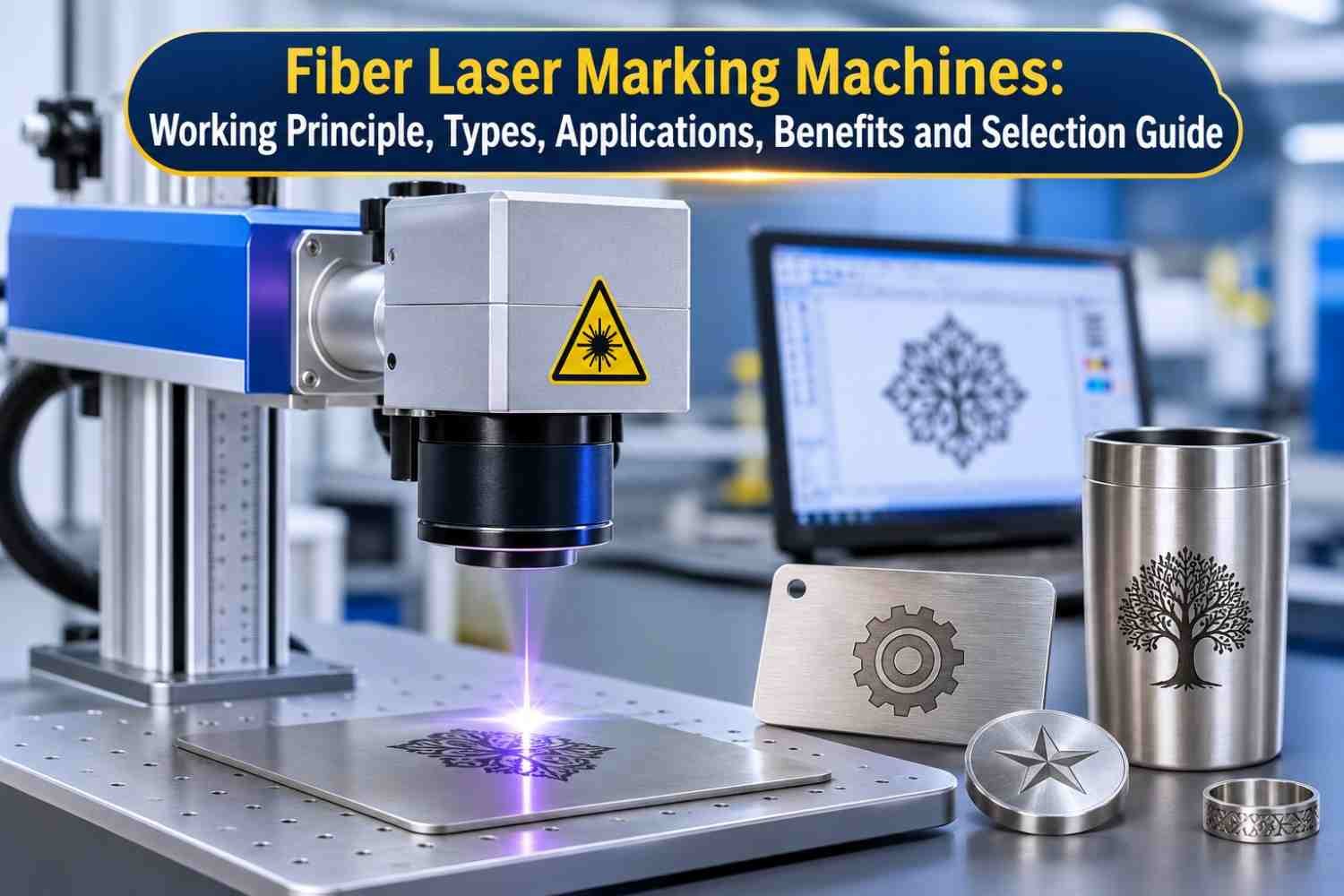
The laser marking machine works on the principle where the laser beam is generated, focused, and directed to the selected surface following the pattern that is digitally designed.
Here is how the process works:
- Design preparation: The operator creates or imports text, numbers, logos, barcodes or other artwork into the marking software.
- Laser generation: The laser source produces a concentrated beam of light through an optical fibre.
- Beam direction: Galvanometer scanning mirrors direct the beam across the required marking area.
- Surface interaction: The focused laser energy interacts with the material, changing its surface appearance or removing a small amount of material.
- Mark formation: The programmed design appears on the product as a permanent mark.
Parameter adjustment by the operator is possible for power, speed, frequency and pulse duration as per the material and desired outcome. Right testing can ensure good contrast, clarity and depth of marking.
Types of Fiber Laser Marking Machines
Production needs dictate different types of lasers. Two common types of lasers include Q-switched lasers and MOPA fiber lasers.
1. Q-Switched Fiber Laser Marking Machines
The Q-switched laser emits very short and very powerful laser pulses. This type of laser is used widely in marking and engraving on metals like stainless steel, aluminum, brass and similar alloys.
Such lasers will be ideal where the need arises to have normal markings done on products like logo, serial number, product code.
2. MOPA Fiber Laser Marking Machines
MOPA means Master Oscillator Power Amplifier. The MOPA laser technology provides flexibility with the variable pulse durations and the wider variety of pulse frequencies when compared to many conventional Q-switched setups.
This extra level of control will allow the manufacturers to get different types of surface finish and marking results. In addition, the MOPA laser technology is used for some color marking applications on stainless steel and special marking of selected plastics.
The correct solution depends on the desired finish, material and manufacturing process, as well as on budget. The machine should be chosen based on sample tests, not only its specifications.
Common Applications of Fiber Laser Marking Technology
The fiber laser marking technology provides means for product identification and traceability in various industries. The suitability of the process depends on the material and markings needed.
Common laser marking machine applications include:
- Automotive manufacturing: Marking component numbers, identification codes and manufacturing details on metal parts.
- Electronics: Adding product information, serial numbers and identification marks to compatible components.
- Jewellery: Engraving names, designs, logos and other details on suitable metal jewellery.
- Medical equipment: Marking identification and traceability information on compatible instruments and components.
- Hardware manufacturing: Adding logos, model numbers and product codes to tools, fasteners and metal fittings.
- Industrial equipment: Marking machine parts, metal panels and components for identification and inventory management.
However, manufacturers may also consider employing laser marking for QR and Data Matrix codes, if the chosen settings ensure adequate contrast and readability.
Materials Suitable for Fiber Laser Marking
Fiber lasers are quite effective with many metal types, such as stainless steel, aluminum, brass, copper, titanium, and some other alloy types. In addition to that, Fiber laser marking machines can mark chosen engineering plastics and coating materials, according to their properties.
Nevertheless, material compatibility is also quite crucial in laser processes. A fiber laser will not always be effective with any surface. Materials like transparent items, wood, paper, and glass need a different laser type and technology.
For instance, CO₂ lasers usually fit wood, paper, and glass processes, while UV lasers may help to engrave delicate marks on chosen plastics and other materials.
To ensure the quality and eliminate any potential problems, you should test your exact material type and coating before the production process.
Key Benefits of Fiber Laser Marking Machines
Businesses consider fiber laser systems for several practical reasons:
Permanent and Clear Markings
Laser marking can produce marks that withstand normal handling and wear and tear. It is dependent on the mark depth and the working environment.
Non-Contact Processing
It is through the laser beam that the surface is marked, but there is no physical tool that comes into contact with the part in question.
High Precision
In circumstances where the application and settings are appropriate, high-resolution text and logos can be generated using a concentrated beam and controlled scanning.
Minimal Consumables
The method usually does not involve the use of ink, marking ribbons, or labels, which may decrease the need for such supplies management.
Digital Design Flexibility
Marking content may be updated by means of suitable software program. It is beneficial for instances where various products use different serial numbers, batches, and designs.
Integration with Production
The proper systems can operate together with lighting, automation, and assembly line procedures. It is necessary to integrate the needed elements according to the machine configuration.
How to Choose the Right Fiber Laser Marking Machine
Choosing a machine merely on the basis of cost or power rating may result in an inappropriate choice. Take into account these considerations before proceeding.
- Material compatibility: Confirm whether the machine can mark your exact material and surface finish.
- Laser power: Compare available power options according to the required marking speed, depth and production volume.
- Marking area: Choose a working field that accommodates your product dimensions and marking layout.
- Required finish: Decide whether you need surface marking, deep engraving, high-contrast codes or specialised finishes.
- Laser source: Evaluate the Fiber Laser Source based on its specifications, application suitability, service support and manufacturer information.
- Software and connectivity: Check whether the system supports your required file formats, variable data and production workflow.
- Safety features: Review the enclosure, interlocks, warning labels and operating instructions. Never assume that an open-beam system is safe without appropriate controls.
- After-sales support: Ask about installation, operator training, maintenance and technical assistance.
When comparing Laser Engraving Machines for businesses, it is equally as important to verify that the machines are compatible with the type of material and finish desired. Demonstrating with your own product will allow you to see the end result before you buy.
can be taken into account when researching industrial laser marking machines. It would be wise to speak with the supplier about your material, marking needs, and production requirements before choosing a machine.
Fiber Laser Marker vs Other Laser Technologies
In most cases, a Fiber Laser Marker is an excellent choice for metal marking. But it does not mean that it will always be the best option to use.
- Fiber laser: Commonly preferred for metals and selected engineering plastics.
- CO₂ laser: Often suitable for wood, paper, acrylic, glass and other compatible non-metal materials.
- UV laser: Useful for fine marking on selected heat-sensitive materials where lower thermal impact is important.
The right technology is determined by the wavelength, absorbency, condition of the surface, and desired outcome.
Conclusion
Fiber laser marking machines assist the manufacturers in applying permanent identification marks, product codes, and designs with a non-contact method. They are used in a wide variety of applications including automotive parts, electronic components, jewelry, hardware, and industrial machinery.
To ensure that you choose the appropriate machine, consider the type of material, marking area, desired finish, source of laser, safety aspects and technical support before you decide on a machine. Conducting tests on sample materials will help you avoid making expensive decisions regarding your laser marking machine choice.
A good Fiber Laser Marker will help you in creating product identification and maintain organized manufacturing process with respect to machine, material and process specifications. Talk to Daksh Enterprises about your marking needs to get appropriate laser marking machine for your business.