
No products in the cart.
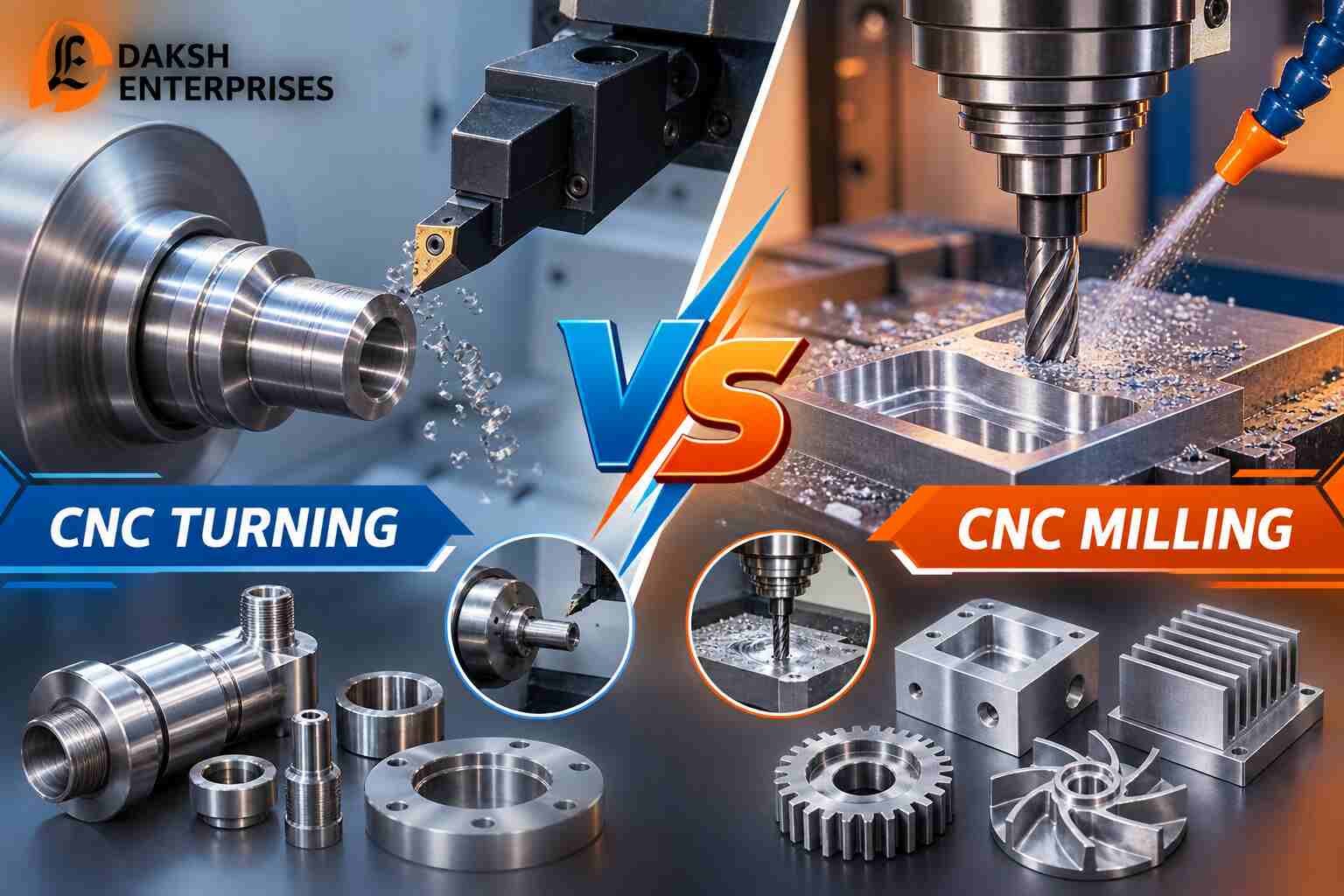
Choosing between CNC turning and milling depends less on which machine is better and more on what you need to manufacture. For example, a CNC wood carving machine serves a different purpose from metal machining equipment. Both turning and milling use Computer Numerical Control (CNC) to automate material removal, but they move the workpiece and cutting tool differently. Understanding that difference can help manufacturers select the right machining process for accuracy, geometry, production volume, and cost.
What Is CNC Machining?
CNC machining is a form of subtractive manufacturing. Instead of adding material layer by layer, the machine removes material from a workpiece until it reaches the required shape.
A digital design usually begins in CAD software. CAM software then converts the design into machine instructions that control movements such as the tool path, cutting speed, feed rate, and other machining parameters.
CNC machines can produce repeatable components with controlled dimensions and complex features. CNC milling and CNC turning are two of the most widely used machining processes.
What Is CNC Turning?
The turning process rotates the workpiece while a cutting tool removes material from its surface. This makes CNC turning particularly suitable for parts with rotational symmetry, such as shafts, bushings, pins, bolts, and cylindrical components.
A CNC lathe normally holds the workpiece in a Chuck connected to the spindle. The workpiece rotates at a controlled spindle speed, while the cutting tool moves along the required path.
Common turning operations include:
- Facing
- External turning
- Internal boring
- Threading
- Grooving
- Taper turning
The exact operation depends on the required geometry and machining requirements.
Because the workpiece rotates continuously during cutting, turning can be highly effective for producing repeated cylindrical parts.
Also Read: Laser vs Plasma Cutting: Which Is Better for Your Metal Cutting Business in 2026?
What Is CNC Milling?
Unlike turning, the milling process generally holds the workpiece stationary while a rotating cutting tool removes material.
A CNC Milling Machine can move the cutting tool along multiple axes to create flat surfaces, pockets, slots, holes, contours, and more complex three-dimensional features.
Common milling tools include an End Mill and Drill Bit. Different tools and tool paths allow manufacturers to perform different machining operations on the same workpiece.
Milling can support 3-axis, 4-axis, and 5-axis configurations. The available axes and machine configuration determine how the tool and workpiece can move during machining.
CNC Turning vs Milling: The Main Difference
The simplest way to understand the turning and milling difference is to look at what rotates.
In CNC turning:
- The workpiece rotates.
- The cutting tool removes material from the rotating part.
- It works particularly well for round and symmetrical components.
In CNC milling:
- The workpiece generally remains fixed.
- The rotating tool moves across the workpiece.
- It works particularly well for flat, irregular, angled, and complex geometries.
Autodesk describes the same fundamental distinction: turning rotates the workpiece against the cutting tool, while milling uses a rotating tool against a stationary workpiece.
Think of it this way: if the part wants to spin, turning may be the natural choice. If the tool needs to travel around the part, milling may make more sense.
Turning vs Milling: Key Factors to Compare
1. Part Shape
Part geometry should be one of the first considerations.
CNC turning suits cylindrical, conical, and rotationally symmetrical parts. Milling offers greater flexibility for components containing pockets, slots, flat surfaces, angled features, and complex contours.
Neither process wins every job. The part decides.
2. Cutting Tool Movement
Turning commonly uses a stationary or controlled cutting tool while the workpiece rotates. Modern turning centers can also incorporate live tooling for additional machining operations.
Milling uses a rotating cutting tool that moves relative to the workpiece. This gives the machine considerable flexibility when creating complex features.
3. Material Removal
Both processes remove material through controlled cutting.
During turning, the rotating workpiece presents material to the cutting tool. During milling, the rotating tool engages the workpiece along a programmed path.
Parameters such as cutting depth, feed rate, spindle speed, tool selection, and material influence the final result.
4. Machining Accuracy
Both CNC turning and milling can support high machining accuracy when the machine, tooling, programming, workholding, and process parameters suit the application.
However, accuracy does not come from the CNC label alone. Proper setup and process control matter.
Manufacturing organizations such as NIST also recognize CNC milling and turning as important subtractive manufacturing processes and include them within manufacturing and inspection environments.
5. Surface Finish
The required surface finish can influence process selection.
Turning can produce consistent cylindrical surfaces, while milling can create controlled flat, contoured, and pocketed surfaces. Tool condition, cutting parameters, material, machine rigidity, and programming all affect the finished surface.
So, rather than assuming one process always creates a better finish, manufacturers should evaluate the actual part requirements.
CNC Turning and Milling: When Should You Choose Each?
Choose CNC Turning When:
- The component is primarily cylindrical.
- The design contains rotational features.
- You need repeated shafts, pins, bushings, or similar components.
- Threading or turning operations form a major part of the job.
- Production involves many similar round components.
Choose CNC Milling When:
- The component has flat or irregular surfaces.
- The design includes pockets and slots.
- You need complex contours or angled features.
- Multiple cutting directions are required.
- The component requires detailed prismatic or 3D features.
For more complicated components, manufacturers can also consider mill-turn technology. These machines combine turning and milling capabilities, allowing certain parts to undergo multiple operations in one setup. This can reduce handling and improve process consistency.
What About CNC Woodworking?
CNC machining is not limited to metal manufacturing.
Woodworking applications also use computer-controlled machines for cutting, carving, routing, and engraving. A CNC wood carving machine can create decorative patterns, relief designs, furniture components, and other detailed wooden features.
Similarly, a CNC wood engraving machine can reproduce programmed designs consistently across multiple pieces.
For workshops producing furniture, doors, panels, decorative products, and signage, CNC woodworking equipment can provide repeatable results while reducing repetitive manual cutting work.
When selecting woodworking equipment, factors such as material type, work area, spindle performance, tooling, design complexity, and production requirements should be considered.
CNC Spindle and Machine Performance
The spindle plays an important role in machining performance. In milling applications, it drives the rotating cutting tool, while CNC spindle equipment uses the spindle to rotate the workpiece.
Spindle speed must match the material, tool, operation, and other cutting conditions. Running a tool faster is not automatically better. Sometimes faster simply means your tool has found a very expensive way to complain.
For woodworking applications, manufacturers may also compare equipment such as a CNC wood router based on the material, cutting requirements, work area, spindle configuration, and intended production volume.
CNC Turning and Milling Applications
Both machining methods support a wide range of industries.
Automotive Manufacturing
Manufacturers use turning for components such as shafts, bushings, and other rotational parts. Milling can produce brackets, housings, fixtures, and components with complex features.
Aerospace Manufacturing
Aerospace components often require controlled geometry and dimensional accuracy. CNC milling supports complex shapes, while turning suits rotational components.
Medical Manufacturing
CNC machining can produce precision components for medical equipment and other applications where controlled dimensions and repeatability matter.
General Engineering
Industrial machinery, fixtures, tools, prototypes, and custom components can use either process depending on the part design.
CNC Turning vs Milling: Quick Comparison
| Factor | CNC Turning | CNC Milling |
| Main movement | Workpiece rotates | Cutting tool rotates |
| Best suited for | Round and cylindrical parts | Complex and irregular parts |
| Typical machine | CNC lathe | CNC milling machine |
| Common tools | Turning tools | End mills, drills and other milling tools |
| Typical features | Threads, grooves, shafts | Slots, pockets, holes, contours |
| Multi-axis capability | Available on advanced machines | Common in advanced configurations |
| Main advantage | Efficient rotational machining | Greater geometric flexibility |
Which Is Better: CNC Turning or Milling?
There is no universal winner in CNC turning and milling.
If your component mainly consists of cylindrical or rotational features, CNC turning is often the logical choice. If your design contains pockets, slots, flat surfaces, angled features, or complex contours, CNC milling may be more appropriate.
For components requiring both types of operations, mill-turn technology can combine capabilities within one CNC environment.
The best choice should consider part geometry, material, tolerances, production quantity, tooling, machine capability, setup requirements, and total production cost.
Final Thoughts
CNC turning and CNC milling handle different tasks. When turning, the part spins while the cutting tool shapes it. This method works well for round parts. In milling, the part stays in place and the tool moves instead. Milling can make many shapes and details.
Picking the method should start with the part. Look at the drawing first. Check the size and form, the material, and the tolerance needs. Also review the production pace and the surface finish you want.
When a shop is looking at CNC machines, these points help a lot. You can choose equipment that fits the work, not the other way around. Daksh Enterprises can assist if you want help deciding on a CNC setup for your use case. Reach out so we can talk through what you need and find a good match.
Frequently Asked Questions (FAQs)
What is the main difference between CNC turning and milling?
The main difference is how the machine moves the workpiece and cutting tool. In CNC turning, the workpiece rotates while the cutting tool removes material. In CNC milling, the workpiece generally remains fixed while a rotating cutting tool moves across it.
Which is better, CNC turning or milling?
Neither process is universally better. CNC turning is generally more suitable for cylindrical and rotational parts, while CNC milling works well for components with flat surfaces, pockets, slots, holes, and complex contours. The part design should determine the process.
What parts can be made using CNC turning?
CNC turning is commonly used for cylindrical or rotational components such as shafts, pins, bushings, threaded parts, and other round components. The exact applications depend on the machine configuration, tooling, material, and required geometry.
What parts can be made using CNC milling?
CNC milling can produce components with flat surfaces, pockets, slots, holes, contours, and other complex features. It is useful for manufacturing brackets, housings, fixtures, molds, and many custom components.
Is CNC turning faster than CNC milling?
It depends on the part and machining requirements. Turning can be highly efficient for cylindrical components because the workpiece rotates continuously during cutting. Milling may require more tool movements for complex geometries, but it can be highly productive for suitable parts.
What materials can CNC turning and milling machines process?
Both processes can work with many engineering materials, including different metals and plastics. The appropriate cutting tool, spindle speed, feed rate, cutting depth, and machining parameters depend on the material and application.
What role does a CNC spindle play?
The spindle provides controlled rotation for the machining process. In milling, it typically rotates the cutting tool. In turning, the spindle commonly rotates the workpiece. Spindle speed and machine capability influence cutting performance and machining results.
Can one CNC machine perform both turning and milling?
Yes. Mill-turn or turn-mill machines combine turning and milling capabilities in one machine platform. They can be useful when a component requires both rotational and milling features, potentially reducing the need for multiple setups.
What factors should I consider before choosing a CNC machine?
Consider the part geometry, material, dimensional requirements, production volume, required surface finish, tooling, machine size, number of axes, automation level, and overall production requirements. Choosing based only on machine price can lead to an unsuitable setup.
Are CNC turning and milling suitable for mass production?
Yes. CNC turning and milling can support repeatable production when the machine, tooling, programming, workholding, and process parameters are properly selected. The better option depends on the geometry and requirements of the parts being produced.