
No products in the cart.
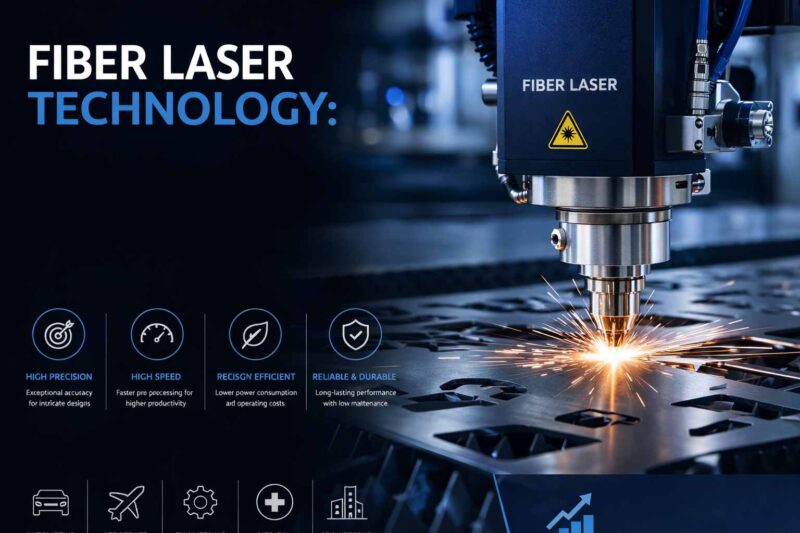
In today’s fast-evolving industrial world, businesses are constantly searching for technologies that deliver speed, accuracy, and long-term cost efficiency. Fiber laser technology has emerged as a game changer, offering a perfect balance of precision engineering and operational reliability.
At Daksh Enterprise, we provide advanced laser solutions that help industries upgrade their production capabilities while maintaining consistent quality. Understanding how fiber lasers function and where they add value can help businesses make smarter investment decisions.
The Science Behind Fiber Laser Innovation
The development of fiber lasers depends on an advanced optical system that enables light production and amplification through flexible fiber transmission. Fiber lasers operate through solid optical fibers which contain rare-earth element dopants, unlike traditional laser systems that use mirrors and gasbased technology.
The system produces a stable beam which maintains its strength throughout extended manufacturing operations. The controlled movement of light within the fiber ensures minimal energy loss and maximum output efficiency. The ability of fiber lasers to create extremely detailed work enables their use in both heavy industrial tasks and precise technical operations.
Long-distance beam quality preservation enables automated systems to function without interruption, which has become essential for operations in contemporary manufacturing facilities.
Why Industries Are Rapidly Adopting Fiber Lasers
The shift toward fiber laser technology is not just a trend—it is driven by real operational advantages that directly impact productivity and profitability.
One of the most significant reasons for this adoption is the speed at which fiber lasers operate. Compared to traditional methods, they can process materials much faster while maintaining consistent accuracy. This reduces production time and allows businesses to handle higher volumes without compromising quality.
Another key factor is reliability. Fiber lasers are designed with fewer mechanical components, which means there is less wear and tear over time. This leads to reduced downtime and lower maintenance costs, both of which are crucial for industries operating on tight schedules.
Energy efficiency also plays a major role. Fiber lasers convert electrical energy into laser light with remarkable efficiency, helping businesses reduce electricity consumption and operational expenses in the long run.
Also Read : Fiber Laser vs CO2 Laser: Which One Is Best for Your Business
Precision Engineering and Material Compatibility
Fiber lasers demonstrate their primary strength through their capability to process various materials with particular focus on metal components. The shorter wavelength produced by fiber lasers allows better absorption by metallic surfaces, resulting in cleaner cuts and stronger welds.
The automotive and electronics and tool manufacturing industries require this level of precision because their operations face major losses from even minor inaccuracies. Fiber lasers ensure that every cut, mark, or weld is execute with high consistency.
A fiber laser marker is commonly used in marking applications to create permanent high-contrast markings that maintain their visibility over extended periods. The system provides essential functionality for product identification and branding and traceability purposes.
Performance Stability in Continuous Operations
Machines in industrial environments require continuous operation capacity because their performance needs to stay at full capacity throughout their operational lifetime. Fiber lasers are well-suited for such conditions because their design provides both strong protection and effective thermal control capabilities.
The optical fiber implementation in its internal design enables regular heat distribution throughout its structure which keeps temperature control systems from overheating while delivering consistent performance through prolonged operation. This makes fiber lasers ideal for high-volume production lines where consistency is critical.
The machine maintains its accuracy throughout time because it does not need complex alignment systems which decrease the frequency of required adjustments.
Role of Fiber Lasers in Modern Automation
The integration of fiber lasers into automated systems enables their use within robotic production lines and CNC machines. Modern fiber laser systems combine their advanced capabilities with intelligent control systems which monitor system performance and adjust operational parameters to achieve peak performance.
The system achieves both efficiency gains and human error reduction through this process. Automated systems maintain their operational efficiency through a high-quality fiber laser source which provides reliable performance across all production volumes.
Expanding Applications Beyond Metal Processing
Fiber lasers are used for metal processing tasks, but their applications extend to multiple industries. The technology is now being apply in electronic fields and medical device production and artistic design work.
The textile industry uses a fabric laser cutting machine to achieve precise cutting results which protect the integrity of the material. The system achieves two benefits, which include complete elimination of manual cutting work and faster production processes.
The electronics industry uses fiber lasers to perform micro-marking and engraving tasks which need precise measurement capabilities to tiny dimensions.
Long-Term Value and Return on Investment
The advantages of fiber laser technology extend beyond its current performance because it delivers value that lasts over time. Organizations that implement fiber lasers throughout their operations will achieve decreased operational expenses which will continue throughout their business duration.
Investors receive high returns because the system combines low maintenance needs with its ability to operate efficiently while delivering service for extended periods. Fiber lasers provide businesses with reliable performance which lasts for multiple years unlike traditional systems that need regular maintenance and component upgrades.
They provide businesses with an ideal solution which enables them to expand their operations while keeping their expenses at controlled levels.
Also Read : 10 Smart Ways to Scale a Manufacturing Business Without Increasing Costs
Safety, Sustainability, and Modern Industry Standards
Safety and environmental responsibility have gained growing importance for industrial operations. The requirements of these operations are met through fiber lasers, which provide a safer and cleaner processing method that replaces traditional techniques.
The product operates as an environmentally friendly solution because it generates almost no waste while excluding dangerous chemical substances from its operation. The implementation of enclosed systems together with fume extraction systems provides advanced safety features that protect employees in their work environment.
The transition of industries to sustainable practices has established fiber lasers as a dependable solution that meets future requirements.
Choosing the Right Partner for Fiber Laser Solutions
The process of selecting an appropriate fiber laser system requires more than just choosing a system. The selection of an appropriate supplier stands as a crucial factor that determines whether a company will achieve sustainable success.
Daksh Enterprise establishes its operational foundation by studying the particular needs of every client and delivering solutions that meet their production requirements. Our specialized knowledge together with modern technological systems enables us to create efficient dependable systems.
We provide full service to our clients which includes everything from initial consultation to final installation and ongoing support after sales.
Conclusion
Fiber laser technology is creating new manufacturing standards which are now use in contemporary production methods. The technology provides industries with a vital asset which combines exactness and rapid output together with operational effectiveness.
Businesses can achieve higher productivity and better quality results when they choose suitable technologies and work together with established companies such as Daksh Enterprise Contact us today to get started with the right fiber laser solution for your business.
Fiber lasers will maintain their position as leading edge technologies which drive sustainable manufacturing improvements throughout industrial sectors.
Frequently Asked Questions (FAQs)
1. What is a fiber laser machine used for?
A fiber laser machine is used for cutting, marking, engraving, welding, and cleaning materials, especially metals. It is widely used in industries such as automotive, manufacturing, electronics, and fabrication.
2. Why should I choose fiber laser technology over traditional methods?
Fiber laser technology offers higher precision, faster processing speed, lower maintenance, and better energy efficiency compared to traditional machining and CO₂ laser systems.
3. What materials can be processed using a fiber laser?
Fiber lasers are mainly used for metals like stainless steel, aluminum, brass, and copper. They can also work on certain plastics and coated materials depending on the application.
4. How long does a fiber laser machine last?
A fiber laser machine can last up to 100,000 working hours depending on usage, maintenance, and operating conditions, making it a long-term investment for businesses.
5. Is a fiber laser suitable for small businesses?
Yes, fiber lasers are available in different power ranges and configurations, making them suitable for both small businesses and large-scale industries.