
No products in the cart.
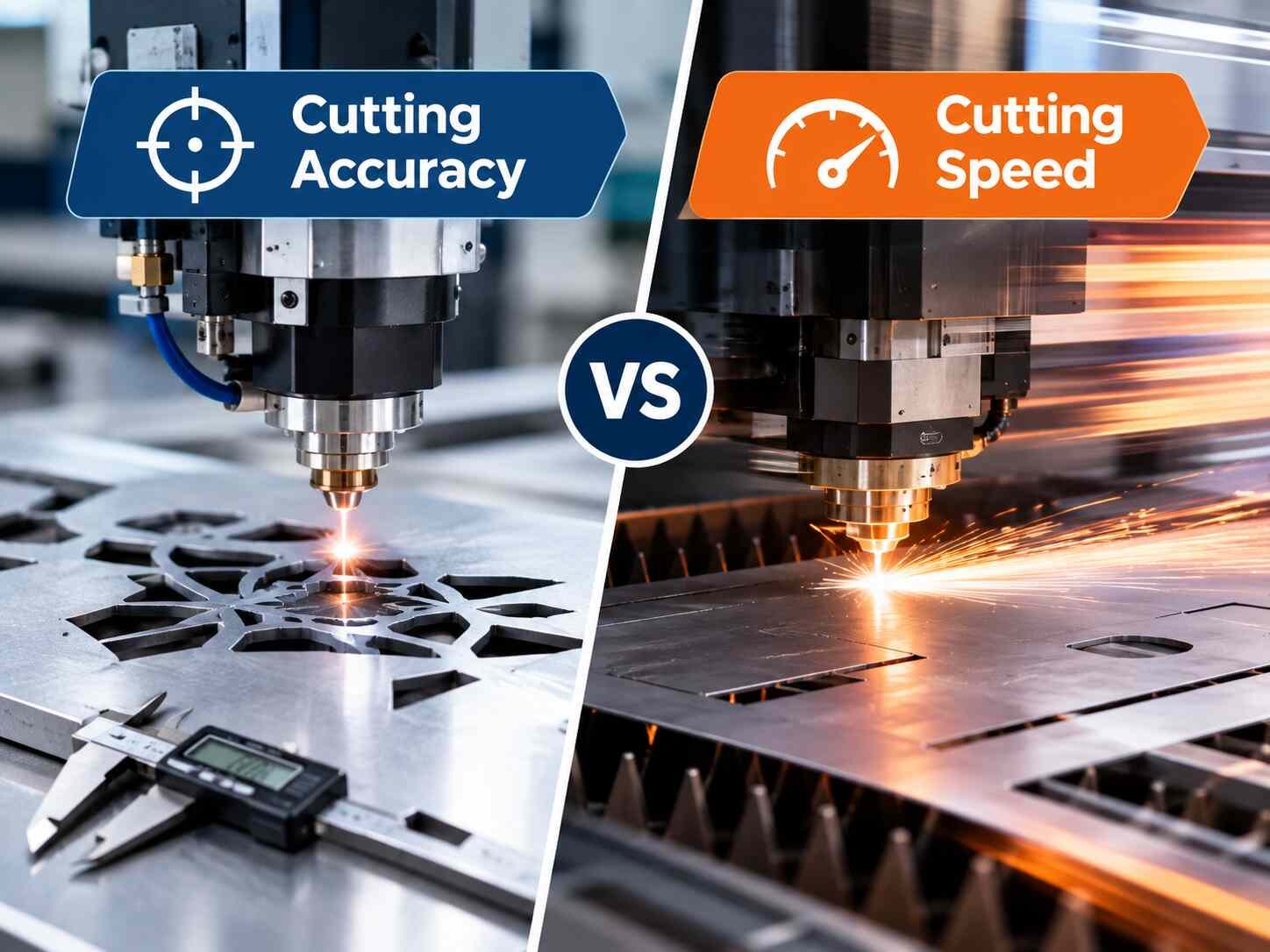
When choosing a cutting machine, businesses often ask the same question: should they focus on speed or precision? The answer is not as simple as choosing the fastest machine available. Cutting accuracy vs cutting speed depends on the material, design, production volume, required tolerance, and final application. A laser metal cutting machine, for example, may suit applications where fast and precise sheet processing matters, while CNC equipment can offer greater flexibility for different machining tasks.
The goal is not to make a machine work as fast as possible. The goal is to achieve the required cutting quality at a practical production speed.
What Is Cutting Accuracy?
Cutting accuracy refers to how closely the finished workpiece matches the intended dimensions and design.
In manufacturing, even a small dimensional difference can matter when components need to fit together. This is why machining accuracy, tolerance, repeatability, and surface finish play important roles in production.
Good cutting precision can help businesses maintain consistent dimensions across multiple workpieces. However, accuracy does not depend on one machine setting alone.
Machine calibration, tool condition, material properties, cutting parameters, toolpath design, and operator setup can all influence the final result.
For CNC machining, parameters such as spindle speed and feed rate need to match the machine, tooling, material, and machining operation. Autodesk notes that there is no single feed-and-speed setting that works for every machine and application.
Also Read: Laser vs Plasma Cutting: Which Is Better for Your Metal Cutting Business in 2026?
What Does Cutting Speed Mean?
Cutting speed describes how quickly a machine performs a cutting operation.
Higher production speed can reduce cutting time and help businesses process more workpieces within a given production schedule. That sounds great until speed starts affecting quality.
Increasing speed without considering the material and machine setup can create problems such as poor surface finish, unwanted heat, tool wear, or inaccurate cuts.
For CNC equipment, cutting speed relates to factors such as feed rate, spindle speed, tool diameter, material, and machining strategy. Autodesk defines spindle speed as the rotational speed of the spindle and cutting feedrate as the feed used during cutting movements.
Laser cutting follows a different process. TRUMPF explains that cutting speed depends on the cutting task and material, while increasing material thickness generally reduces the achievable cutting speed. Laser power also plays an important role.
Cutting Accuracy vs Cutting Speed: Why Both Matter
So, cutting accuracy vs cutting speed, which matters more?
It depends on what your business produces.
If you manufacture components that require tight dimensions, cutting precision may take priority. If you process large quantities of relatively simple parts, production speed may have a stronger impact on overall efficiency.
The important point is balance.
A machine that cuts extremely fast but produces parts that require frequent correction may not deliver better production efficiency. On the other hand, a machine that produces highly accurate parts but takes too long for your workload may not meet your production requirements.
In simple terms:
Accuracy protects quality. Speed supports productivity.
The right machine should provide both at a level that matches your work.
Also Read: CNC Turning and Milling: What’s the Difference and Which Is Better?
How Material Affects Cutting Performance
Material compatibility is one of the first things to consider before comparing machine performance.
Different materials respond differently to cutting processes. Material thickness, hardness, density, heat response, and surface characteristics can affect cutting parameters.
For example, a CNC router can be useful for woodworking applications, while a fiber laser cutting machine is designed for specific metal-processing applications.
TRUMPF’s laser cutting information shows that laser power, focus position, nozzle selection, material and thickness all influence the cutting process.
This means you should not compare machines only by a headline speed. Always ask how the machine performs with the materials and thicknesses your business actually processes.
CNC Machines: Accuracy, Speed and Flexibility
A CNC machine uses computer-controlled instructions to guide machining operations. CAM software can generate toolpaths that control machine movements, including spindle speed and feed rate.
A CNC router can work well for applications involving wood, plastics and other suitable materials. A CNC wood router can perform cutting, shaping and routing operations based on programmed toolpaths.
For detailed woodworking and decorative applications, a CNC wood carving machine can provide controlled movement for patterns, lettering and complex designs.
A CNC engraving machine can also create detailed designs where controlled tool movement matters.
The CNC spindle is another important component because it drives the cutting tool. The CNC controller interprets programmed instructions and coordinates machine movements.
A CNC cutting machine therefore offers more than simple speed. It provides programmable control that can support repeatable manufacturing processes.
Laser Technology: Where Speed Meets Precision
Laser technology uses a focused laser beam to process material. Modern laser systems can provide precise cutting while maintaining high production speeds, depending on the machine configuration and application.
A fiber laser is widely used for metal-processing applications. A fiber laser source generates the laser energy used by the system, while components such as the laser cutting head help direct and focus the beam onto the material.
TRUMPF notes that the focus position affects the kerf and that laser power, nozzle diameter, operating mode and cutting speed all influence the cutting process.
A fiber laser cutting machine can therefore be a suitable option for businesses that need efficient sheet-metal processing.
Laser systems are not limited to fiber technology. A CO2 laser uses a different laser source and can be used for suitable cutting and engraving applications. Components such as a CO2 laser tube and laser chiller are associated with these systems.
The right choice depends on the material, application and required production process.
Does Faster Cutting Always Mean Better Production?
Not necessarily.
Imagine two machines. Machine A completes a job quickly but produces inconsistent edges. Machine B takes slightly longer but produces parts that require little or no additional correction.
Which one is faster in real business terms?
That is where production efficiency becomes more important than the machine’s advertised production speed.
Businesses should consider the complete workflow, including setup, cutting, inspection, finishing, rework, maintenance and material handling.
A fast machine can lose its advantage if operators spend extra time correcting poor results.
When Accuracy Should Come First
Accuracy should receive greater attention when your products require:
- Tight dimensional tolerance
- Consistent component fitting
- Detailed designs
- Clean cutting edges
- Repeatable production
- High-quality surface finish
- Complex geometries
For these applications, chasing maximum speed may not make sense.
A controlled cutting process can reduce errors and help maintain consistent output.
For example, precision cutting can be important when producing components that need to fit with other manufactured parts. The required level of accuracy should come from the product specification rather than from a generic machine claim.
When Speed Should Come First
Speed becomes more important when your business handles:
- High production volumes
- Repetitive cutting jobs
- Large numbers of similar workpieces
- Time-sensitive orders
- Applications where extremely tight tolerance is not necessary
However, high-speed cutting still requires suitable cutting parameters.
For CNC machining, feed rate and spindle speed should match the tool, material and machine setup. Autodesk specifically notes that machine rigidity, horsepower, tooling and the type of machining operation can influence suitable feeds and speeds.
For laser cutting, material thickness and available laser power also influence achievable cutting speed.
How to Choose the Right Balance for Your Business
Before purchasing or upgrading a machine, ask five practical questions:
1. What materials do you process?
Identify the materials and their typical thicknesses. Your machine must support your actual material cutting requirements.
2. What level of tolerance do you need?
Do not pay for capabilities your products do not require. At the same time, do not choose a machine that cannot meet your required tolerance.
3. What is your production volume?
Low-volume custom work and high-volume production can require very different machine priorities.
4. How complex are your designs?
A CNC router or CNC wood carving machine may suit certain three-dimensional or woodworking applications, while laser systems can be effective for specific sheet-cutting and engraving processes.
5. What does the complete workflow look like?
Consider setup, programming, cutting, inspection, maintenance and operator requirements. The machine should fit the entire production process, not just one step.
For businesses researching a suitable machine locally, you can check the Daksh Enterprises location and business information through its Google Business Profile before making an enquiry or visiting.
What About a Laser Metal Cutting Machine?
A laser metal cutting machine can be relevant when a business needs efficient processing of suitable metal sheets and components.
Modern fiber laser systems can process materials such as mild steel, stainless steel and aluminum, with machine capability varying by laser power, configuration and material thickness. TRUMPF publishes machine-specific technical data showing that cutting capability changes with laser power and material.
That is why businesses should avoid choosing equipment solely on maximum speed. Look at the machine’s actual specifications for your material, thickness and production requirements.
Accuracy vs Speed: The Practical Answer
There is no universal winner in the cutting accuracy vs cutting speed debate.
If your products depend on tight dimensions and consistent quality, accuracy may deserve greater priority.
If your business handles large production volumes and your tolerances allow faster processing, production speed may carry more weight.
In many cases, the best approach is to find a machine that delivers the required accuracy without sacrificing practical production speed.
Think of it this way: a machine does not earn extra points for finishing first if the parts need to be remade.
Final Thoughts
Choosing between cutting accuracy and cutting speed should start with your product, material and production requirements.
CNC technology can provide programmable machining and flexibility across suitable applications. Laser technology can provide precise and efficient cutting for appropriate materials and processes. Both depend on correct machine settings, material compatibility and proper operation.
Before investing in manufacturing equipment, compare cutting parameters, material thickness, tolerance, production volume, maintenance requirements and total workflow.
The right machine is not simply the fastest or the most precise. It is the one that delivers the cutting performance your business actually needs.