
No products in the cart.
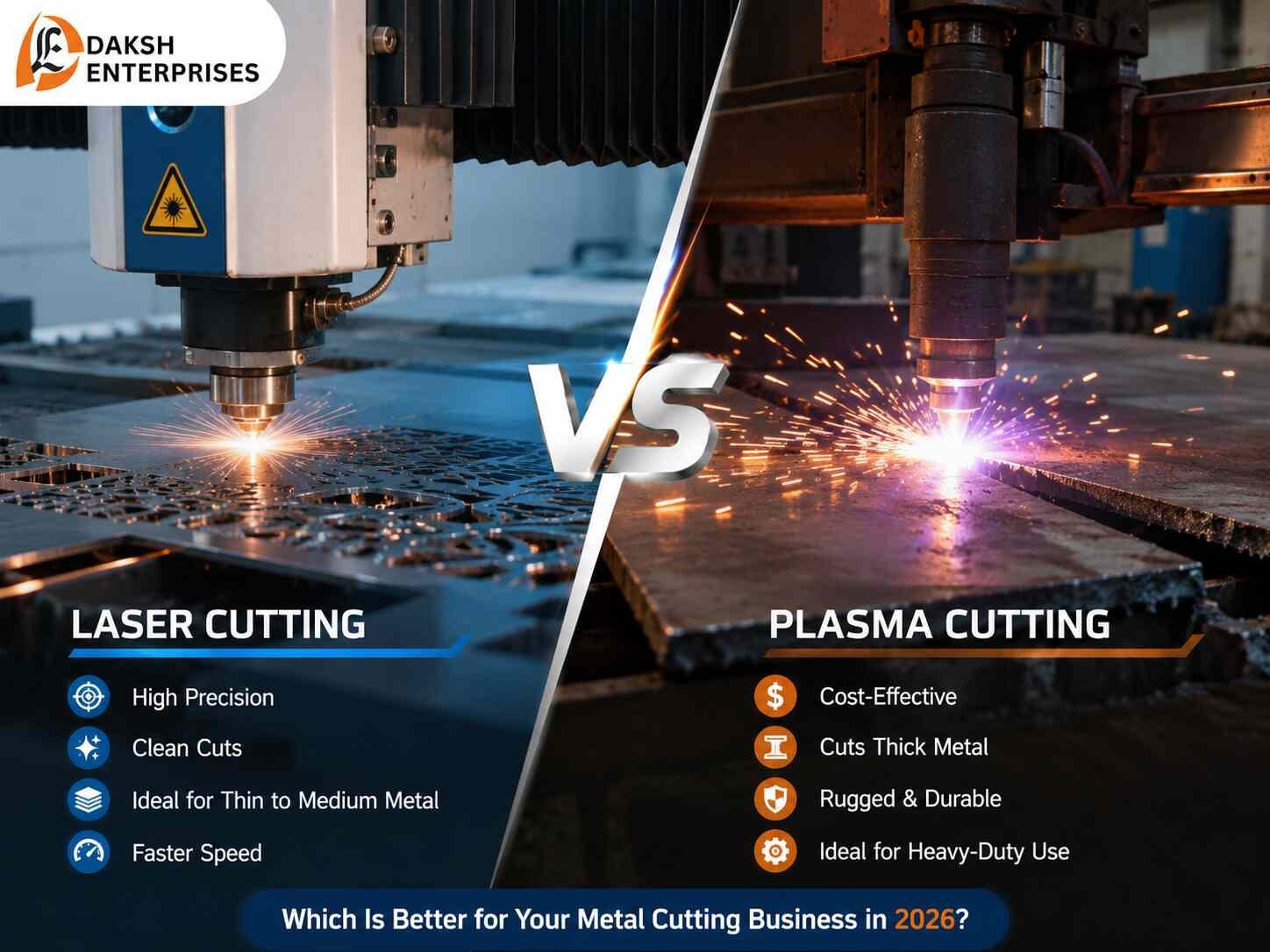
Choosing the right metal cutting technology is not as simple as picking the newer machine. A business that already uses a fiber laser marker may be familiar with laser technology, but cutting metal involves different requirements. In laser vs plasma cutting, the right choice depends on material thickness, cutting speed, accuracy, operating cost, production volume, and the type of parts you manufacture.
Both technologies have a strong place in modern metal fabrication. The real question is not which machine is universally better. It is which technology fits your production requirements better.
What Is Laser Cutting?
Laser cutting uses a concentrated beam of light to heat and cut material. In modern metal fabrication, fiber laser systems are widely used because they can deliver high precision and narrow cuts.
A laser cutting machine works with a cutting head, laser source, motion system, CNC control, and assist gas. The focused beam follows a programmed cutting path to produce the required shape.
Fiber laser cutting is particularly useful when manufacturers need detailed shapes, high cutting accuracy, and consistent results on suitable materials and thicknesses.
Laser technology can also support other applications. For example, businesses may use laser engraving machines for marking and engraving applications, while a separate fiber laser cutting system handles sheet and plate cutting.
What Is Plasma Cutting?
Plasma cutting uses an electrical arc and a high-velocity stream of ionized gas to melt and remove electrically conductive metal.
A plasma cutting machine can cut materials such as Mild Steel, Stainless Steel, Aluminum, Copper, and Brass. CNC systems can automate the cutting path, making CNC cutting suitable for repeated production work.
Plasma has been used in industrial metal cutting for decades. Modern high-definition plasma systems can produce much better cut quality than the old image many people have of rough plasma cuts. The American Welding Society notes that current high-definition plasma can rival fiber laser for many customer requirements.
Also Read: CNC vs Laser Cutting: Which Technology Is Right for Your Business?
Laser Cutter vs Plasma Cutter: Key Differences
The most useful way to compare laser cutter vs plasma cutter is to look at the factors that directly affect your workshop.
| Factor | Fiber Laser | Plasma |
| Thin metal | Excellent | Good |
| Fine details | Excellent | Good |
| Thick metal | Depends on power and application | Strong advantage |
| Cutting accuracy | Very high | High with modern systems |
| Initial machine cost | Generally higher | Generally lower |
| Material condition | More sensitive | More forgiving |
| Maintenance | More specialized | Generally simpler |
| Automation | Excellent | Excellent |
| Best fit | Precision and thin-material work | Versatile and thicker-metal work |
These are general comparisons, not universal rules. Actual performance varies with machine configuration, material, thickness, power, consumables, and cutting parameters.
Cutting Speed and Material Thickness
Cutting speed is one of the most important factors when comparing plasma vs laser cutting.
Fiber lasers can offer a significant speed advantage on thinner metals. As material becomes thicker, however, the advantage can be reduced and plasma can become more productive.
The American Welding Society reported in February 2026 that fiber lasers typically have a strong speed advantage on materials up to around 12 mm, while plasma can become faster as thickness increases. The exact crossover depends on laser power and the specific process.
This is why material thickness should come before marketing claims when choosing a machine.
If your workshop mainly processes thin sheet metal and requires intricate profiles, fiber lasers may be the better fit. If your work frequently involves thick plates, plasma deserves serious consideration.
Cutting Accuracy and Cut Quality
For precision cutting, fiber lasers have a clear advantage in many applications. Its narrow beam can produce a narrow kerf and fine features, which helps when parts require tight tolerances or intricate shapes.
However, plasma should not be dismissed as a low-quality option.
Modern high-definition plasma systems can produce smooth, consistent edges and meet the requirements of many fabrication applications. The American Welding Society reports that high-definition plasma can deliver cut quality that rivals fiber laser for many customer requirements.
So, if your customers demand extremely fine features, lasers may be preferable. If the job mainly involves larger profiles, structural components, or parts prepared for welding, modern plasma may provide more than enough cut quality.
Operating Cost and Machine Cost
Cost involves more than the purchase price.
You should consider the machine cost, electricity, gas, consumables, maintenance, labor, downtime, and material waste when comparing cutting technologies.
Fiber laser systems generally require a larger initial investment than comparable plasma systems. Hypertherm and the American Welding Society both note that fiber laser systems can cost roughly two to five times as much as comparable plasma systems, although actual pricing varies significantly by machine, power, automation, and supplier.
Operating cost also changes with the material being processed. Fiber laser can be highly efficient on thinner material, while plasma can offer an operating-cost advantage as material becomes thicker.
Do not calculate ROI from the machine price alone. Calculate the cost per finished part.
Maintenance and Workshop Conditions
Maintenance can make a noticeable difference to long-term production efficiency.
Fiber laser systems contain precision optical and motion components. They need appropriate cleaning, inspection, and service to maintain cutting performance. A clean working environment also matters because contamination can affect optical components and precision systems.
Plasma systems are generally more robust and straightforward to maintain. Their consumables, such as electrodes and nozzles, require replacement as they wear, but many maintenance tasks can be handled by an in-house team.
Other workshop equipment matters too. For example, a laser setup may require supporting equipment such as laser chillers, depending on the system configuration.
Material Condition Matters
A detail that buyers sometimes overlook is the condition of the material.
Fiber laser systems can be more sensitive to rust, mill scale, coatings, and other surface conditions. Plasma is more forgiving when working with imperfect conductive materials.
For a workshop that regularly receives clean sheet metal and needs precise parts, fiber laser can be an excellent choice.
For a fabrication environment that works with painted, rusty, coated, or variable-condition conductive metal, plasma can offer practical advantages.
Which One Is Better for Your Business?
There is no universal winner in laser cutting vs plasma cutting.
Choose fiber laser when your business prioritizes:
- High precision
- Fine and complex profiles
- Thin sheet metal
- Narrow kerf
- Automated production
- Consistent detailed parts
Choose plasma when your business prioritizes:
- Thicker metal
- Lower initial investment
- Robust operation
- Versatility with conductive materials
- Easier maintenance
- Large fabrication work
For businesses that process a wide range of materials and thicknesses, owning both technologies can sometimes make more sense than forcing every job through one machine. The American Welding Society reached a similar conclusion in its 2026 comparison: the best solution depends on material, thickness, production requirements, automation, service, and expected payback.
What About Other Laser Applications?
Laser technology is not limited to cutting. Different systems serve different manufacturing requirements.
A fiber laser source powers many industrial fiber laser systems used for cutting and marking metals. Meanwhile, engraving systems can serve applications where detailed surface marking is the priority.
This distinction matters when selecting equipment. A machine designed for marking is not automatically the right machine for cutting thick metal.
Final Verdict: Laser or Plasma?
The answer to laser vs plasma cutting depends on your actual production mix.
If you care most about tight tolerances, fine detail, and thin parts, a fiber laser cut can work well. If you often cut thicker metal parts that conduct well, and you want sturdy gear, a smaller upfront cost, and easier day to day upkeep, plasma might fit better.
Before you decide, look at the thickness you cut most, how much you run each week, the accuracy you need, the state of your metal, your power and operating costs, how much work upkeep takes, and what your buyers expect.
The best cutting technology is not necessarily the most expensive or newest one. It is the one that consistently produces the parts your business needs at a cost your business can sustain.
For manufacturers evaluating metal cutting and related industrial equipment, Daksh Enterprises can help you select equipment based on your actual application, material, thickness, and production requirements. Contact us to discuss your requirements and find a suitable machine for your business.
Frequently Asked Questions (FAQs)
Which is better, laser cutting or plasma cutting?
Neither technology is better for every application. Fiber laser cutting generally suits precision work, intricate designs, and thinner sheet metal, while plasma cutting can be a practical choice for thicker conductive metals and applications where a lower initial machine investment matters.
Is laser cutting more accurate than plasma cutting?
Generally, fiber laser cutting provides higher precision and is well suited to detailed shapes and tight tolerances. Modern high-definition plasma can also deliver excellent cut quality, so the right choice depends on the required tolerance and application.
Which is faster, laser or plasma cutting?
Cutting speed depends on the material, thickness, machine power, and cutting conditions. Fiber lasers can be very fast on thinner materials, while plasma can become more productive as material thickness increases.
Can plasma cut stainless steel and aluminum?
Yes. Plasma cutting works with electrically conductive metals, including stainless steel and aluminum. It can also cut mild steel, carbon steel, copper, and brass when the machine and process are suitable.
Is fiber laser cutting suitable for thick metal?
Fiber laser systems can cut a wide range of metal thicknesses, but their practical cutting range depends on laser power, material type, machine configuration, and required cut quality. For very thick plate, plasma may offer advantages.
Which has lower operating costs, laser or plasma?
There is no universal answer. Operating costs depend on electricity, assist or cutting gases, consumables, maintenance, material utilization, production speed, and the thickness being processed. Compare the total cost per finished part rather than one expense alone.
What should I consider before buying a metal cutting machine?
Consider your typical material, material thickness, production volume, required cutting accuracy, machine cost, operating cost, maintenance requirements, available space, and expected return on investment. Your actual production mix should guide the decision.
Can CNC be used with both laser and plasma cutting?
Yes. Both laser and plasma systems can be integrated with CNC controls for automated cutting. CNC technology helps machines follow programmed cutting paths and produce repeatable parts.
Does laser cutting produce less material waste?
Laser cutting can reduce material waste because its narrow cutting path allows precise cutting and efficient part nesting. However, actual material utilization depends on the part design, nesting strategy, kerf, and production process.
Should a small metal fabrication business choose laser or plasma?
A small business should choose based on its typical jobs rather than business size alone. If the work focuses on precision and thinner materials, fiber laser may be suitable. If the business frequently handles thicker conductive metals and wants a robust, lower-investment option, plasma may be more appropriate.